

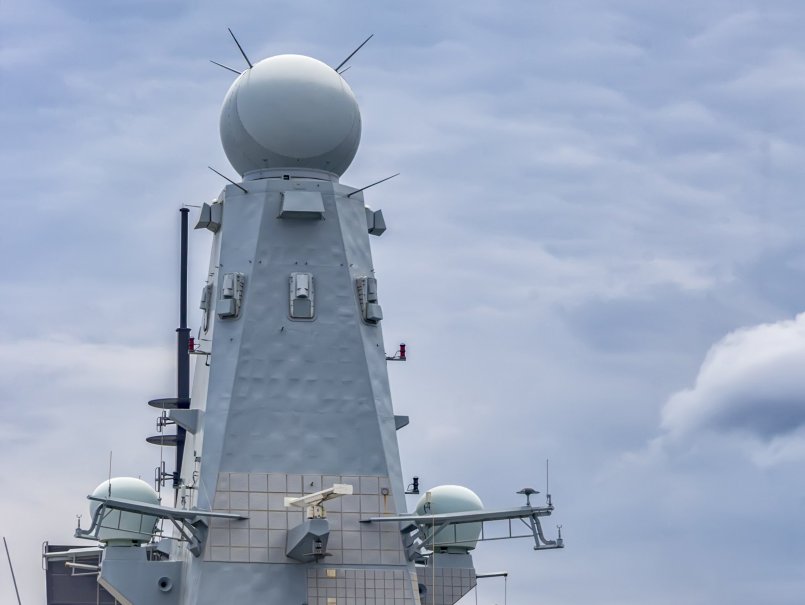
An innovating project that seeks to revolutionize naval communications is being led by the university. This is the “Metasurface Optimized Radome for Communications and Advanced Protection” project, better known as Meta-Orca, an investigation project that aims to develop multifunctional radomes that will improve communication signals transmission and simultaneously offer mitigation of electromagnetic interference and protection against severe maritime environmental conditions.
Meta-Orca is focused on the design, manufacture and validation of advanced radomes based on metasurfaces for naval platforms, such as surface ships and other high-demand maritime applications. The initiative seeks to develop intelligent covers for ship antennas that not only physically protect communication systems from the marine environment, but also improve quality of communications and reduce interference.
Thanks to new materials and advance design, these covers allow antennas to work better and be more discret from an electromagnetic perspective, contributing to safer, more reliable and efficient communications in the naval field.
The study – framed within an Anillo Project funded by the National Research and Development Agency (ANID, for its name in Spanish), that is directed by the professor of the School of Electrical Engineering at the PUCV, Francisco Pizarro – combines advanced electromagnetic designs, 3D printing techniques, characterization of artificial materials or metamaterials, and experimental validation, with a strong component of applied I+D and technological transfer, in collaboration with the chilean naval industry.
“Radomes are structures that can protect antennas from the elements and that traditionally, must be electromagnetically transparent, this is, that they do not interfere with the properties of the antenna. However, this project proposes to take advantage of this existing structure and add a special feature to the antenna. So, we no longer want it to be transparent, but we seek to use its mechanics to achieve specific goals through the use of metamaterials”, Pizarro explained.
Antennas with new characteristics
The main objective is to develop multifunctional radomes that allow to improve communication signal transmission, while simultaneously offering mitigation from electromagnetic interferences, reduction of electromagnetic mark and protection against unfavorable maritime conditions.
This project – carried out in collaboration with ASMAR, the University of Technology Sydney, the Universidad Politécnica in Cartagena, Spain; the Universidad Carlos III de Madrid and the Universidad Técnica Federico Santa María, in Chile – has critical applications to the military and naval field, such as the reduction of visibility in front of radars.
“We could also modify the radome so it is capable to absorb the energy from possible electromagnetic attacks that could burn the circuits; or change the way in which the antenna irradiates, without modifying the antenna itself, but to have the radome available for these types of tasks”. Pizarro noted.
Interdisciplinary International Project
The research project has included chemical engineering experts to ensure that the materials endure the required salinity and humidity conditions of the marine environment. The team is currently working on a real scale prototype that they hope to complete no later than three more years to validate this innovative technology.
To this respect, Dreidy Vásquez, scholar from the School of Chemical Engineering at the PUCV, explained that metamaterials are materials designed so their properties depend more on the surface than their chemical composition. She underscored that “radomes are structures that protect the antenna and for naval applications they must meet a combination of very specific mechanical, chemical and electromagnetic features. With metamaterials we would be able to optimize the combination of these features”.
“Knowledge is not exclusive to one person or organization, and these types of innovations require visions from different disciplines until making them a reality, so the more collaboration, both nationally and internationally, you can find in a project, the more knowledge is enriched, and results are achieved faster. This is an applied research project, and this is outstanding, as well as the advanced human capital training this study will achieve”, Dreidy Vásquez added.
Meta-Orca also contributes to strengthen national abilities in defense-related strategic technologies, communications and complex electromagnetic systems, in agreement with the PUCV Institutional Strategic Development plan, which aims to propel the development of frontier research and creating research that has regional, national and global impact.
By Erika Schubert
Strategic Communication Department