


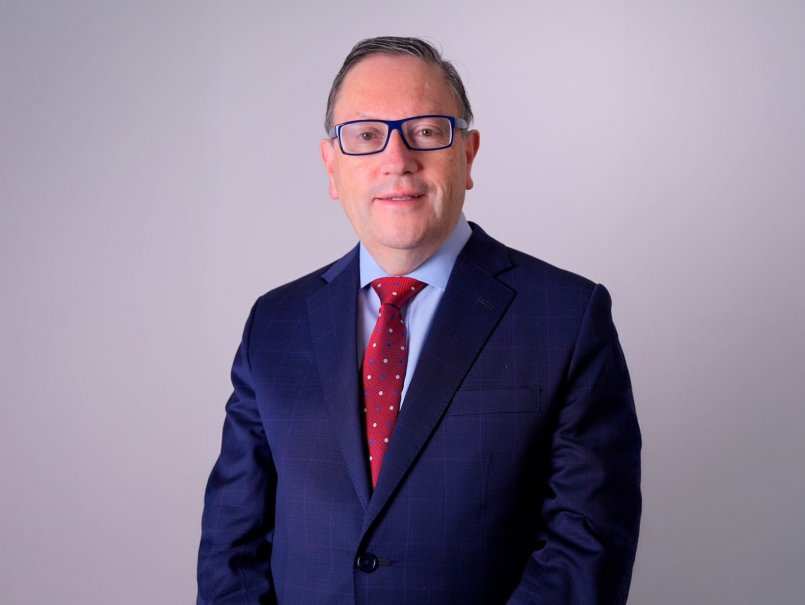
The Dicastery for Culture and Catholic Education of the Vatican officialized the appointment of rector Nelson Vásquez for a new four-year period at the head of our University, ratifying the proposal by the Grand Chancellor and Bishop of Valparaíso, Monsignor Jorge Vega.
Confirmation comes at a moment of special relevance for the university community, since during this new cycle he will have the great responsibility to lead the Centenary celebrations in 2028, a historical milestone that will consolidate academic excellence, public vocation and catholic identity in the Region of Valparaíso and the country during its first century of existence.
Professor Vasquez received confirmation from Rome with gratitude and a sense of responsibility, highlighting the challenges that will come in matters of institutional accreditation, transformational management, research, creation and innovation, education of excellence in undergraduate and graduate levels, internationalization and community engagement.
“I receive this ratification from the Vatican with humbleness, and above all, with a great commitment towards our whole university community. The next four years demand that we consolidate the leadership of the PUCV at the national and international levels. We will live a unique moment such as our Centenary in 2028, a time to honor our history and project a university that is modern, inclusive, with a profound public vocation and of excellence”, she expressed.
Nelson Vásquez Lara
Rector Nelson Vásquez Lara is a professor from the History Institute of the Pontificia Universidad Católica de Valparaíso. He holds a Master 's in History and a Ph.D in Didactics of History and Social Sciences of the University of Barcelona.
Representing the Faculty of Philosophy and Education, he was a member of the Higher Council between 2008 and 2009. He then became Dean (2009-2010) and was the Academic Vicerector from 2010 to 2022. On July 22, of 2022 he was appointed to his first term as Rector of the PUCV.
First Term Milestones
Among the main achievements of his first term leading the Rectorate, we can highlight the participatory creation of the 2023-2029 Institutional Strategic Development Plan, the updating of the Strategic Vision of the University Teaching Qualification Framework, and the creation of the Teacher Development Program and the Professional Training Interdisciplinary Program.
Likewise, an institutional ecosystem was consolidated, which integrates research, innovation and entrepreneurship, strengthening the ability to transform knowledge into tangible solutions with a high impact on society. Within this framework, the University reached strategic milestones that reinforced its leadership, such as being the only non-government university to be awarded a FIU Frontera project, an instrument oriented towards strengthening I+D+i Frontier scientific capabilities, with structural impact and international projection, reasserting its strategic role in the national science, technology and innovation ecosystem. The project seeks to articulate advanced research, train human capital, innovation and knowledge transfer around critical challenges in Chile regarding health and wellbeing, with a focus on people and territorial pertinence.
The university also strengthened its international projection and its identity as a pontifical institution through the historical visit of Cardinal José Tolentino de Mendonça, Prefect of the Dicastery for Culture and Education of the Holy See, an event of special relevance to the university community that highlighted the recognition of the educational project of the Pontificia Universidad Católica de Valparaíso by the Church. His presence fostered high levels of reflection about the current challenges of higher education, reasserting the institutional commitment with dialogue between faith, culture, science and society, as well as the integral training of people.
On the other hand, undergraduate enrollment has seen a sustained increase since 2023, allowing the PUCV to establish itself as the largest University in the Valparaíso region, with 19,000 students.
This development has taken place together with the permanent renovation of its academic offer, oriented towards responding to the nation’s challenges and the new demands of the production and social fields. In the last years the University has strengthened its formative proposal with the incorporation of new programs, expanding opportunities for future generations of students. Among them Chemistry and Pharmacy; Marine Biology; new specialties in Medical Technology, in addition to new professional programs in the Creative Industry field.
In relation to students, the wellbeing policy was updated through the improvement of mental health, prevention, self-care and healthy lifestyle programs. Spaces for assistance, study, eating and meeting were expanded.
In terms of institutional development, the PUCV encouraged, during the last years, one of the more significant infrastructure improvement processes of its recent history, oriented towards improving the university experience, responding to the growth of its academic project and generating spaces according to the challenges of education, research and community engagement.
In this context, new spaces for study, eating, meeting and student services in various campuses were set up, highlighting the inauguration of the new Student Services Center and the upcoming Student Services building of the Engineering Faculty, both initiatives that enhance the quality of services and favor a more integrated university experience.
Other projects are: the new Music Institute building, a high-standard facility that fosters artistic training; the set up of the building destined to the Creative Industries Interdisciplinary Program; the new building of the Institute of Geography, intended to improve teaching, research and interdisciplinary work; and the beginning of the construction of the future School of Food.
An addition to this process is the inauguration of the new Lecture Hall at the Curauma Campus, intended to respond to the increase in enrollment and improve teaching conditions through classrooms and cutting-edge collaborative spaces. Likewise, the new Curauma Sports Field began its operations. This is a modern center that significantly expands the sports facilities of the university and promotes integral education, healthy lifestyles and the development of recreational and high-performance activities for the university community.
This institutional patrimonial consolidation also took a step forward with the acquisition of Casa Losada and the development of the Casa Italia project, both initiatives that contribute to strengthen the university’s presence in the territory, expand its academic capabilities and protect buildings of high historical and heritage value. The whole process has developed under a sustainability approach, reflected on the institutional commitment to become carbon neutral by 2035, incorporating energetic efficiency, sustainability and responsible development criteria as core elements of the future growth of campuses and university infrastructure.
Within the framework of a long-term vision oriented towards strengthening institutional sustainability, the current Rectorate propelled the creation of the PUCV Endowment, a permanent patrimonial fund that is one of the most relevant milestones in terms of strategic management and financial responsibility for the University. This instrument, which was implemented at the end of 2024, seeks to preserve and strengthen the institution’s patrimony foundation, generating resources that contribute to the funding of scholarships, research, innovation, international mobility and academic development projects, protecting, at the same time, capital for next generations.
Meanwhile, the strengthening of the academic body has become one of the strategic cores of the current administration, in agreement with the 2023-2029 Institutional Strategic Development Plan and the challenges faced by the university in terms of training, research, innovation and community engagement. In this context, the PUCV launched a renovation and expansion process of its faculty, including hiring new professors in 22 academic units, covering disciplines such as engineering, sciences, humanities, arts, education and theology.
Strategic Communications Department

