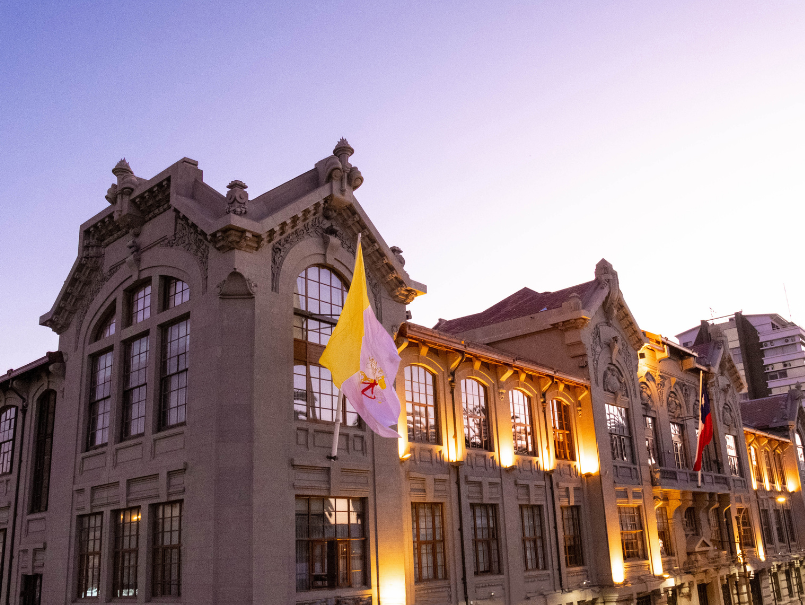


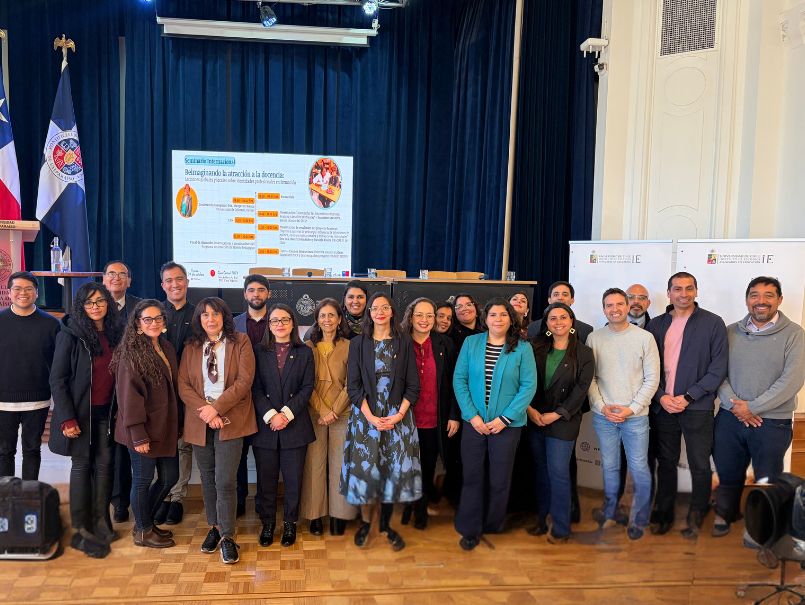
The International Seminar titled “Reimagining attraction to teaching: global and local lessons about professional identities in training”, organized by the Líderes Educativos PUCV Center and the CIAE from the Universidad de Chile, opened a space for dialogue between national public policy, research and experiences of Pedagogical Talent Attraction Programs.
The event took place at the Pontificia Universidad Católica de Valparaíso and was organized within the context of the Fondecyt 1221395 project called “Admission to teaching programs: the influence of policy definitions, institutional changes and individual motivations”, by researchers María Beatriz Fernández, together with co-researchers Carmen Montecinos and Juan Pablo Queupil.
The event began with welcoming words from María Teresa Blanco, interim rector of the Pontificia Universidad Católica de Valparaíso, who noted: “Teacher initial training is of great relevance to our university. This is why we want to share in this international seminar what we have done, but also look at what is taking place at the international level, in order to be able to articulate at the government level, about our initial teacher training”.
“We can proudly say that our university has been a pioneer in these training programs. This is evidenced today by the fact that we have seen a twofold increase in applications for our ‘early talent’ initiative focused on the teaching profession. Why have we achieved these results? Precisely because we have made it our mission to attract talent, develop innovative pedagogy programs, provide ongoing support, and ensure successful integration into the labor market,” she noted.
Addressing teacher retention and shortages: a systemic challenge
The seminar featured an opening presentation by Dr. Margarita Bianco, professor of the School of Education and Human Development at the University of Colorado Denver. Dr. Bianco is the founder of the Pathways2Teaching program, which aims to encourage high school students to pursue a career in education.
In her presentation, titled “Who Will Teach, and Where? Teacher Shortages, Unequal Distribution, and Community-Rooted Training Across Educational Systems,” Dr. Bianco explained how her program encourages students to examine educational inequality as a social justice issue. In this context, she emphasized that the burden of teacher shortages falls most heavily on children with the least access to opportunities, asserting that “brilliant teachers should be where they are needed most.”
Next, speaking from a national perspective with a focus on public policy, Francisco Saavedra, a technical advisor at the Ministry of Education’s Center for Pedagogical Improvement, Experimentation, and Research (CPEIP), addressed current policies aimed at attracting individuals to the teaching profession and strengthening teachers' career paths. Saavedra emphasized that “attracting people to teaching does not end when they enter the profession,” and he outlined the programs currently offered by the CPEIP to provide support, for instance, to novice teachers.
Next, Dr. María Beatriz Fernández and Daniela Rivera, both from the Institute of Advanced Studies in Education and the CIAE at the University of Chile, presented qualitative findings from a Fondecyt project on entry into the teaching profession, titled: “Professional Identities Imagined for the Future by Education Students in Three Programs Designed to Attract Talent to Teaching.”
The researchers highlighted the importance of strengthening university-based programs aimed at attracting pedagogical talent. Their findings suggest that these initiatives allow prospective education students to engage with the true complexity of teaching, helping to disperse the notion that “teaching is easy or merely a technical task.”
The final segment of the event presented a discussion panel with researchers and coordinators from programs designed to attract pedagogical talent: Cristina Arenas and Soffia Ortega (University of Chile), Eder Pinto (University of O’Higgins), and Scarlet Vivanco (Pontificia Universidad Católica de Valparaíso). During this session, the participants presented the programs offered at their respective institutions and discussed the strategies they use to support their students.
To conclude the event, Carmen Montecinos, executive director of the PUCV Center for Educational Leaders (Centro Líderes Educativos PUCV) and co-researcher on the Fondecyt project presented, noted that “the challenge of attracting individuals to the teaching profession requires a systemic effort. Attracting high-quality teachers is not only an issue for universities, the Ministry, or schools; it is a challenge that must be addressed in a systemic and collaborative manner. While the work being carried out with schools is vital, it is also essential to involve regional and ministerial authorities. They can provide the necessary support and create synergy for initiatives driven by universities—initiatives that should, in turn, stem from an integrated approach across the universities’ various academic units and student services.”
Source: Líderes Educativos