


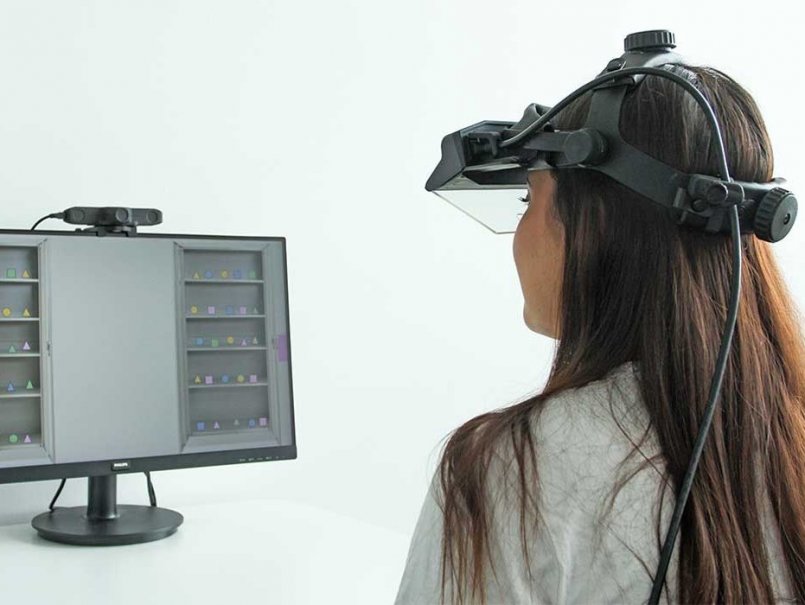
Developing and establishing state-of-the-art associative research about language processing and learning, is the main goal of the project awarded at the 2025 Median XIV Scientific and Technological Equipment Fund (FONDEQUIP for its name in spanish), by the Institute of Literature and Language Sciences (ILCL).
This is an advanced eye-tracking recording equipment that will be employed to strengthen research about associated cognitive processes and learning, contributing to maintaining the national leadership of the PUCV in this field.
The Advanced Dual Eye-tracking is an instrument that is used to record and analyze eye movement patterns during cognitive tasks, making it possible to perform a detailed research of information processing in real-time. It allows gathering of high-precision data and capturing high-speed and short duration ocular phenomena, that appear invisible to less sophisticated equipment.
One of the components of this equipment is the EyeLink 3, a type of new tracking device for on-screen research that provides high-speed sight data (up to 1000 Hz) and follow up information of the head with six degrees of perfectly synchronized freedom.
In addition, it can record high-speed ocular videos, which allows researchers to observe the behavior of underlying data.
The ILCL Scholar and Doctor in Linguistics from the PUCV, Romualdo Ibañez, explained that the great innovation of this equipment is that it allows to record data while moving, which allows to analyze how eyes work in children, adults or elderly people while tasks that demand movement are taking place.
“By incorporating the record of ocular data in movement, we can expand the research questions. We don’t limit ourselves to analyze how the subject solves a mathematical problem or how they move their eyes when reading a text, but we can also see – for example – what an athlete looks at while training or which is the attention focus of a developing child. The questions that one can answer are different, much more diverse, which enriches the research”, Ibañez added.
Impact Research
Thanks to this new equipment, interinstitutional and international collaboration for language processing, aging and cognition is strengthened. This technology reasserts he PUCV’s national leadership, placing it at the cutting edge of this science specialized field in Latin America, together with Brazil.
Ibáñez, who is also Coordinator of the Language and Cognition Lab at the ILCL, explained that “this project intends to create an integration research platform where various teams, national and international, can develop a joint research around ocular follow up technology; we have a research network in Chile, Europe and North America, which will be strengthened with this project”.
Likewise, Ibañez highlighted that other important aspect is the impact this new instrument will have in undergraduate and graduate education. “We train researchers, we have students in the undergraduate, master’s and doctoral levels, whose theses are lodged in the lab and will benefit from these new equipment. We want to install technology as a study methodology that is accessible to all interested students. Until now, in addition to chilean and foreign graduate students, we have seen undergraduate students from the Physical Education programs that have come to work on this. Also, Music, Spanish, English and Translation students”, he added.
Among the research that will be favored with this Fondequip, there are studies about language understanding for people in the Autism Spectrum (TEA for its name in Spanish); the development of epistemic abilities in teenagers; online and off-line effects of reading situation and characteristics of the readers; and second language acquisition, among others. The universities that host this and other projects are the PUCV, the Pontificia Universidad Católica de Chile, the Universidad Católica del Maule, Universidad de La Serena, Universidad Santo Tomás and Universidad de Talca.
By Erika Schubert
Strategic Communications Department