


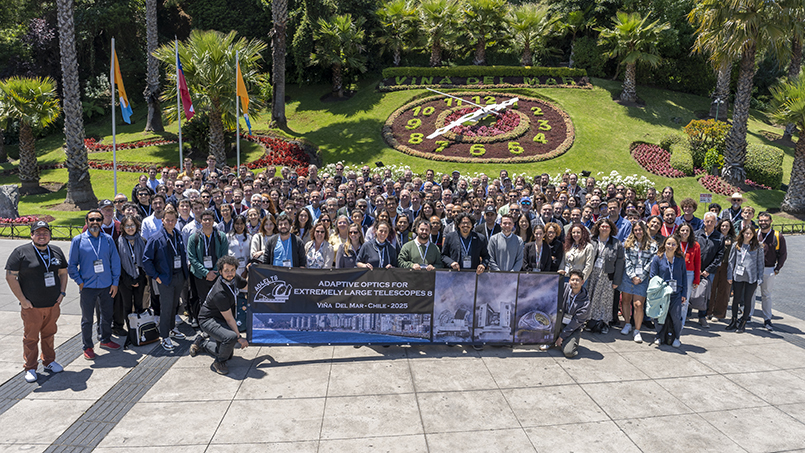
More than 200 specialists from 20 countries were part of the Adaptive Optics for Extremely Large Telescopes (AO4ELT8) conference, the most important international congress devoted to the development of adaptive optics for future extremely large telescopes.
The event, held in Chile for the first time, was organized by the Optolab Optoelectronics Laboratory from the School of Electric Engineering at the PUCV, gathering researchers and scientists from around the world to explore the most recent advances in adaptive optics and to discuss the challenges that come with the development of a new generation of extremely large telescopes (ELT).
This congress has Special relevance for our country, since two of the three extremely large optical telescopes, with a diameter of 25 mts. or more, will be built in chilean territory; one of them is currently under development at the Cerro Armazones.
Global scope collaboration
During five days, more than 240 technical presentations and scientific posters were presented in Viña del Mar, to address the most recent development in adaptive optics, a technology that allows telescopes to compensate distortions of the terrestrial atmosphere and obtain clearer images of the universe. These are essential studies to perform observations of the universe increasing in distance and precision.
Renowned scholars participated on the conference, giving lectures of the highest level. Among them, Jean-Pierre Veran of the National Research Council Canada; Roberto Ragazzoni of the Istituto Nazionale di Astrofisica (Italy); Thierry Fusco from ONERA (France) and Domenico Bonaccini-Calia, representative of Durham University (United Kingdom).
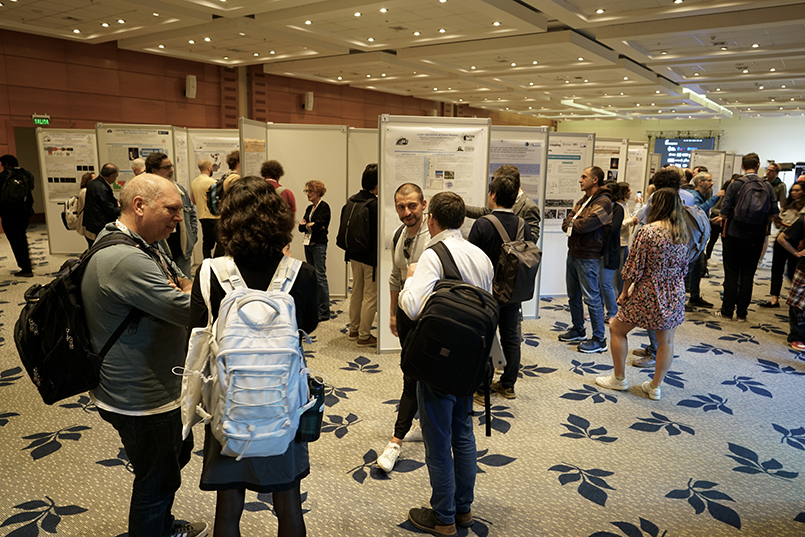
AO4ELT8 also gathered entrepreneurships, research centers and manufacturers that propel the industry behind optical advances, such as Bertin Alpao, Toptica, Nuvu Cameras, Oxford Instruments, TNO, Adoptica, Boston Micromachines, in addition to the INAF and ADONI research centers in Italy, along to the Royal Commission for AIUla (RCU) in Saudi Arabia.
Likewise, there was active participation of the main international extremely large telescope projects: Giant Magellan Telescope (GMT), Thirty Meter Telescope (TMT) and the European Extremely Large Telescope (E-ELT) from ESO.
From Chile, the presence of CCTVal stood out along with ETT Technology Transference and the PUCV Optolab itself, who carried out a live demonstration of a low-cost adaptive optics system based on artificial intelligence, the result of projects funded by the National Agency for Research and Development (ANID, for its name in Spanish)
A milestone for Chilean science
The success of AO4ELT8 in Chile places the country and its higher education institutions – the PUCV among them – as hosts for world class scientific congresses, reasserting its role in the development of technologies for the planet’s most advanced telescopes.
From Viña del Mar, Professor Esteban Vera, researcher and scholar at the PUCV and AO4ELT8 coordinator, emphasized that the event “contributed to strengthen an international community dedicated to improve the quality of astronomic observations”, adding that the congress also “highlighted how technologies associated to adaptive optics will encourage satellite development and space exploration during the next decades”.
With the future extremely large telescopes installed in chilean territory, the progress discussed and developed during AO4ELT8 will be an essential part of the scientific infrastructure that will allow the exploration of exoplanets, the study of the origins of the cosmos and addressing unknown phenomena.
The congress leaves a legacy that positions Chile not only as a host country for large observatories, but also as a protagonist in the creation of key technologies that will offer answers to the next big questions in astronomy and space exploration.
By Antonia López and Magdalena Martínez
PUCV Optoelectronics Laboratory