


Chile plays a key role in the production and exportation of seeds, being the main exporter in the South Hemisphere. Its counter season production - crops in the opposite season to the north hemisphere - helps meet global demands, reduces scarcity and accelerates the development of new varieties of vegetables.
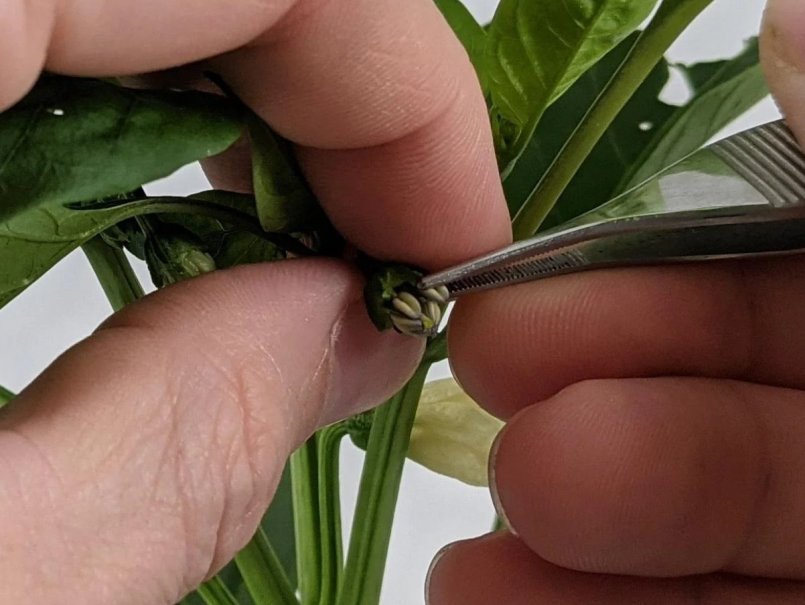
In 2024 alone, the total exportation of seeds was of almost USD$ 400 millions, which represents 38 thousand tons of product, between vegetables, corn, canola, soy, flowers and fodders. New varieties created by geneticists according to global demand are multiplied here in our country. This task is performed manually in some species, by hundreds of operators that manipulate the flowers to pollinize and make the necessary hybridizations. A very detailed process that is achieved with great precision but that, however, is not error-free.
In this scenario, scholars from the School of Electrical Engineering and the School of Agronomy of the University participate in a joint research to design and develop a portable device for monitoring and tracing the process of high-value agricultural seed production.
Daniel Yunge, scholar at the School of Electrical Engineering, the master’s Degree in Engineering Sciences with a mention on Electrical Engineering, and director of the FONDEF IT Project in which this investigation is framed, the idea is that the device captures images and performs reflections at the field and is also capable of detecting errors in the manipulation of flowers during the hybridization process, with the resulting reduction of loss in quality of the production.
“This is a technological solution that, through machine learning, identifies patterns in an image. In this case, images from different moments of the flowers that are worked manually through emasculation and pollination, account for mistakes in the process that can be corrected on time. We are thinking about using a smartphone app since smartphones have the necessary technology for a less costly implementation than a device fabricated especially for monitoring”, Yungue commented.
In order to do this, the project considers the participation of the LEM System company, which offers technological solutions to the agricultural field, such as greenhouse inventory and irrigation systems, and provides data for farmers.
Quality Control
The professor from the School of Agronomy and the Master’s in Agronomic and Environmental Sciences, and co-director of the project, Patricia Peñaloza, commented that seed agriculture in Chile stands out for its quality so it is preferred by multi-national industries for their hybridization processes and the creation of new varieties. She added that “if we add a technological component to quality control of the work that is performed manually, our position at the international level can be even better and this project aims precisely at that”.
About the errors that might be detected by the system, the researcher expressed that “the probability for implicit error in the flower is related to genetics, difficulties in handling and hybridization processes. Errors are not very prevalent today, but have a high cost since the market purchases a specific variety, the genetic identity of a seed, and a minimal error in the process cangenerate a different variety than the desired one. The problem with seed handling is not a matter of volume, but of precision”.
This project will be developed in the Valparaíso Region, which concentrates a great part of the manual hybrid seed production, with a high percentage of women involved in the process as staff. One of the companies linked to this research is Agricola Las Garzas, who provide the seed hybridization service, from plan cultivation to the hiring of the necessary staff.
Sustainability of the agriculture-food industry
Sustainability in management and production of food is a topic that gains more importance each day and impacts public policy at both the national and international levels. In this sense, for Silvia Riquelme, researcher and designer of the University of Concepción project, “the background of seed management is fundamental since we are talking about ensuring nutrition for the future”.
“This is an innovative idea that is completely aligned with what it is sought nationally in agriculture, with the food requirements at the global level and the need to incorporate technological tools to the agricultural industry. Both in Chile and the international level, the goal is to achieve continuous improvement, avoid errors, and create traceability. Data management today is fundamental for the success of any enterprise”, Riquelme complemented.
Finally, Daniel Yunge emphasized that with this project they also hope to improve productivity of those who manipulate flowers to obtain seeds, as well as their quality of life. “At the global level, the bet is to automatize processes to increase productivity, but technology also helps to improvework conditions of people that work in this field, facilitating processes that must take place”.
By Erika Schubert
Strategic Communications Department