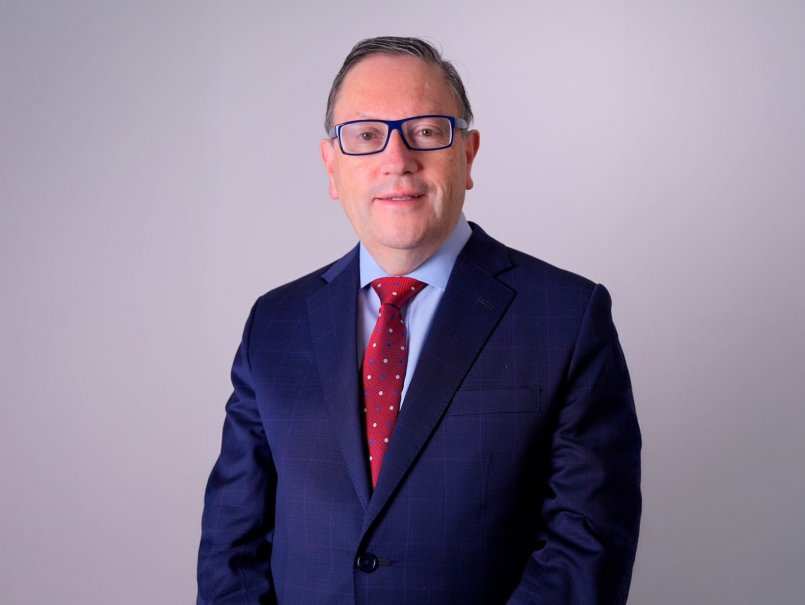


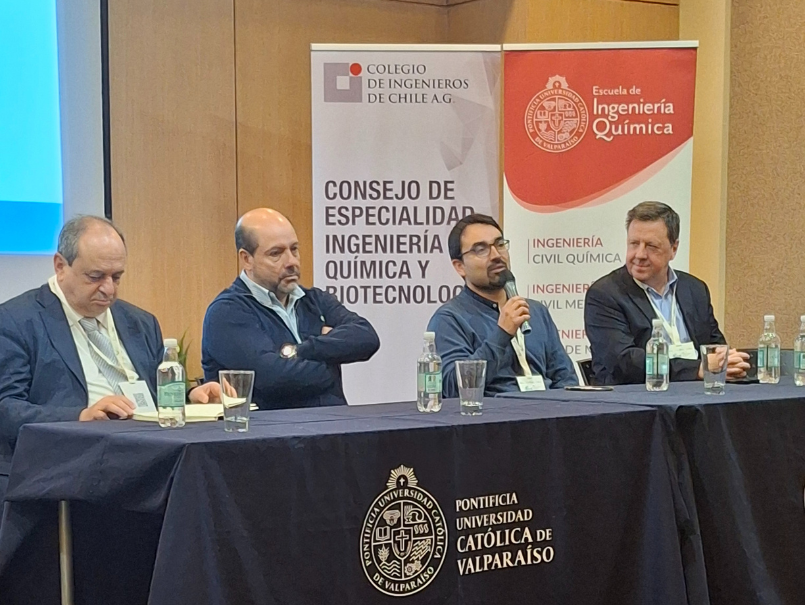
Under the slogan “Innovation for Sustainability”, the XXII Chilean Congress of Chemical Engineering (CCHIQ 2025) took place, gathering researchers, professionals and students from all the country.
The event, organized by the Chemical Engineering School and the College of Engineers in Chile, became a key opportunity for the exchange of knowledge, experiences and scientific advances around technological and environmental challenges faced by the discipline.
The inaugural Ceremony took place in the Honor Hall at our Central Headquarters and welcomed the participation of the Vicerector of Research, Creation and Innovation (VINCI) of the PUCV, Luis Mercado, who highlighted the relationship between the university, industry and government as the driving force for sustainable development. For his part, the Director of the School of Chemical Engineering, Carlos Carlesi, emphasized the long history and collaborative spirit that characterizes this congress, held since 1959.
During the activity, the Energy Regional Ministry Secretary from the Region of Valparaíso, Anastassia Ottone, addressed the challenges of the energetic transition and the importance of training human capital specialized in green hydrogen. Along the same line, Hermann Balde, professional of the same ministry, presented the advances in Energetic Policy 2050, which seeks to achieve a totally clean matrix towards 2040.
Scientific and technological exchange
During the Ceremony, representatives of the Chilean College of Engineers presented the 2025 Outstanding Chemical Engineer Award to Mrs. Gloria Maldonado, highlighting her professional trajectory and her valuable contribution to engineering at the national level.
The congress continued with intense days filled with presentations, plenary sessions and thematic roundtables carried out at the School of Chemical Engineering, which were organized in four main areas: Innovation for Sustainability, Environment, Energy and Hydric Resources, Technology for the Mining Industry and Biotechnology and Food Industry.
Among the plenary conferences we can highlight the following: “New sustainable chemical industry in Chile: the economy of hydrogen”, presented by the energy expert and international consultant Erwin Plett; “Carbon neutral fuels: the case of hydrogen and its by-products”, presented by researcher Mario Marchese, who addressed technological alternatives to advance towards a clean energy matrix; and “New horizons in the regional petrochemical market: challenges, strategies and opportunities”, presented by Manuel Díaz, representative of the Petrochemical and Chemical Latin American Association (APLA).
The program also included keynotes and panels with researchers and industry representatives, among them the PUCV scholar Claudia Altamirano, specialist Katherine Ferrada (Anglo American), scientist José Zagal, and innovators Alex Berg (UdeC) and Catalina Garrido (Liva Company), who addressed issues related to biotechnology, sustainable mining and technological transference between university and industry.
Successful attendance and future projections
During the four days of the congress, more than 200 scientific works in oral and poster format were presented. They addressed topics such as clean energies, circular economy, residue treatment, Biotechnology, food and sustainable mining, reflecting diversity and currency of the chilean engineering work.
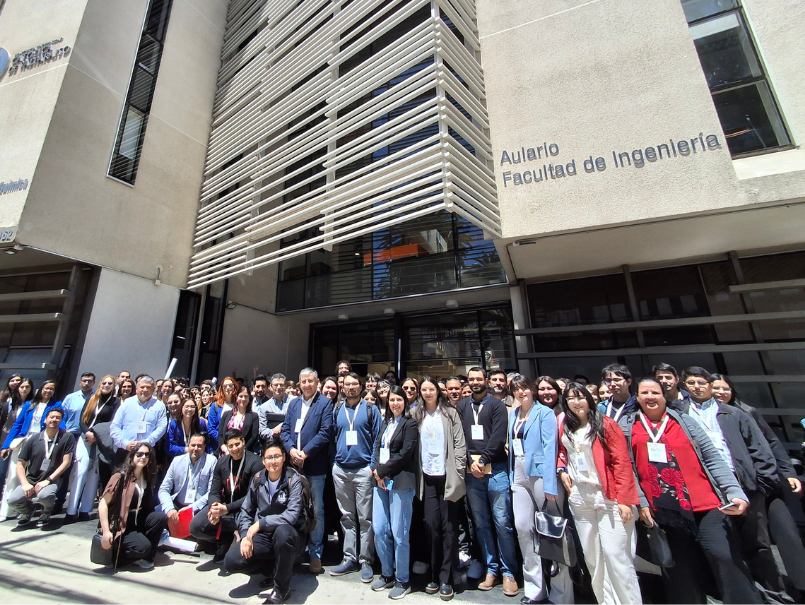
The congress ended with a roundtable about challenges and opportunities of the national chemical industry in the face of de-carbonization and technological innovation, where representatives of APLA, Copec, AIDIS and SQM agreed on the importance of strengthening collaborative work between the academy, industry and Government.
To this respect, Suleivys Nuñez, director of the 2025 CCHIQ Scientific Committee, noted that this congress represented a unique opportunity to demonstrate how national engineering can contribute to the transition to a more sustainable development model. “From the PUCV we wanted to plan a meeting that would integrate the scientific perspective with the industrial reality and public policies, creating a space for dialogue between researchers, businesses and the government. Today, more than ever, technological innovation needs to go hand-in-hand with environmental and social sustainability”, she explained, and added that “Chile has an academic and professional community that is prepared to lead this challenge”.
In this way, the XXII Chilean Chemical Engineering Congress reasserts its place as a key opportunity for academic and professional dialogue in this country, strengthening ties between the university, research and industry looking towards a more innovative and sustainable future.
By María José Valencia
School of Chemical Engineering