


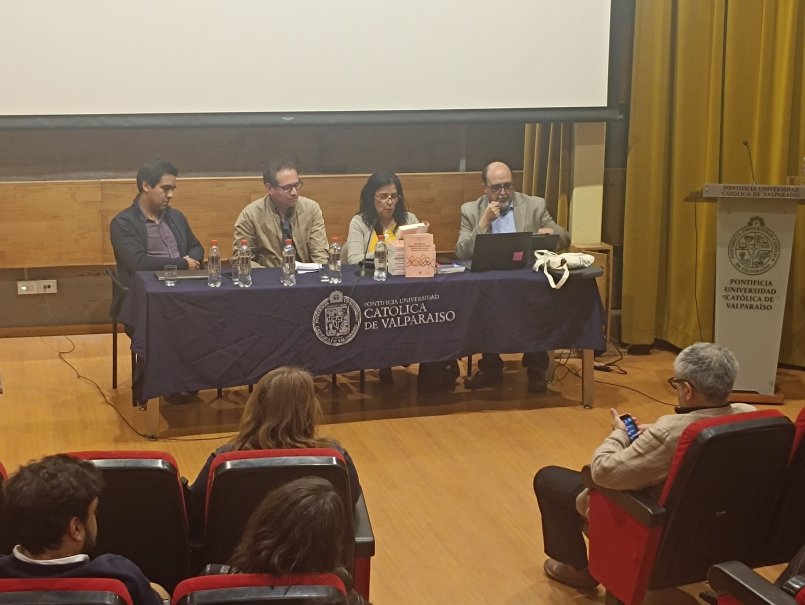
As an active memory exercise and an initiative to strengthen the public incidence of Social Work and promote the discipline, the book “100 years of Social Work in Chile: weaving knowledges to transform the future” was developed. This project was supported by the Vicerectory of Research, Creation and Innovation (VINCI) of the PUCV.
This work was born as an initiative from the researchers of Social Work Network and was co-edited by scholars in the School of Social Work in our University, Sandra Iturrieta and Clément Colin, together with Lucy Ketterer, professor at the Universidad de la Frontera; and gathers articles from 30 scholars from universities throughout the country, with Cecilia Zuleta an María Soledad Ascencio, also faculty members of this university, among them.
Professor Sandra Iturrieta, main promoter of this initiative, highlighted that the book has a very clear goal: “to increase the public incidence of Social Work”, so the discipline is not worn out in the academic field, but will “actively contribute to the debates that society goes through, the dispute for rights, the policy creation and the transformation of common senses about what is just, dignified and possible”, according to what co-editors express in the opening text.
The book presentation was led by Vicerector of Research, Creation and Innovation, Luis Mercado, who commented that when Professor Sandra Iturrieta approached them to request support, “we saw that it was an opportunity to back up these types of initiatives that our scholars are developing. The significant element is the relationship that we can establish so that different Vicerrectors can become aware of the needs arising within the university community”.
Professor Carlos Valdebenito, secretary of the Economic and Administrative Sciences Faculty, to which the Social Work program belongs, referred to the content of the book, which performs an “extensive and dense review of issues that concern us in the various territories that we inhabit”; he also highlighted “the richness of the content that accumulates in this collective intelectual work, and most of all, it’s critical and prospective perspective, that is – without a doubt – a product of the clarity both in the call and the selection carried out”.
During the presentation, the director of the School of Social Work, Edgardo Toro, thanked Professor Sandra Iturrieta for “the opportunity she gives us to come together and share through this book. The excuse is to think together about Social Work. I thank her for her encouragement and energy to write books and do it collectively”.
In a dialogue that also included the participation of Juan Saavedra and Felipe Saravia from the Universidad del Biobío, who collaborated with their own articles, Clément Colin, co-editor of the book, pointed out that this work seeks to account for the “academic and disciplinary diversity” of Social Work and that it also poses reflections and issues in the field of Social Sciences.
By Claudia Carvajal
School of Social Work